
Robbed in Quito
And failing at being a traveler

August 31 – September 28, 2024.
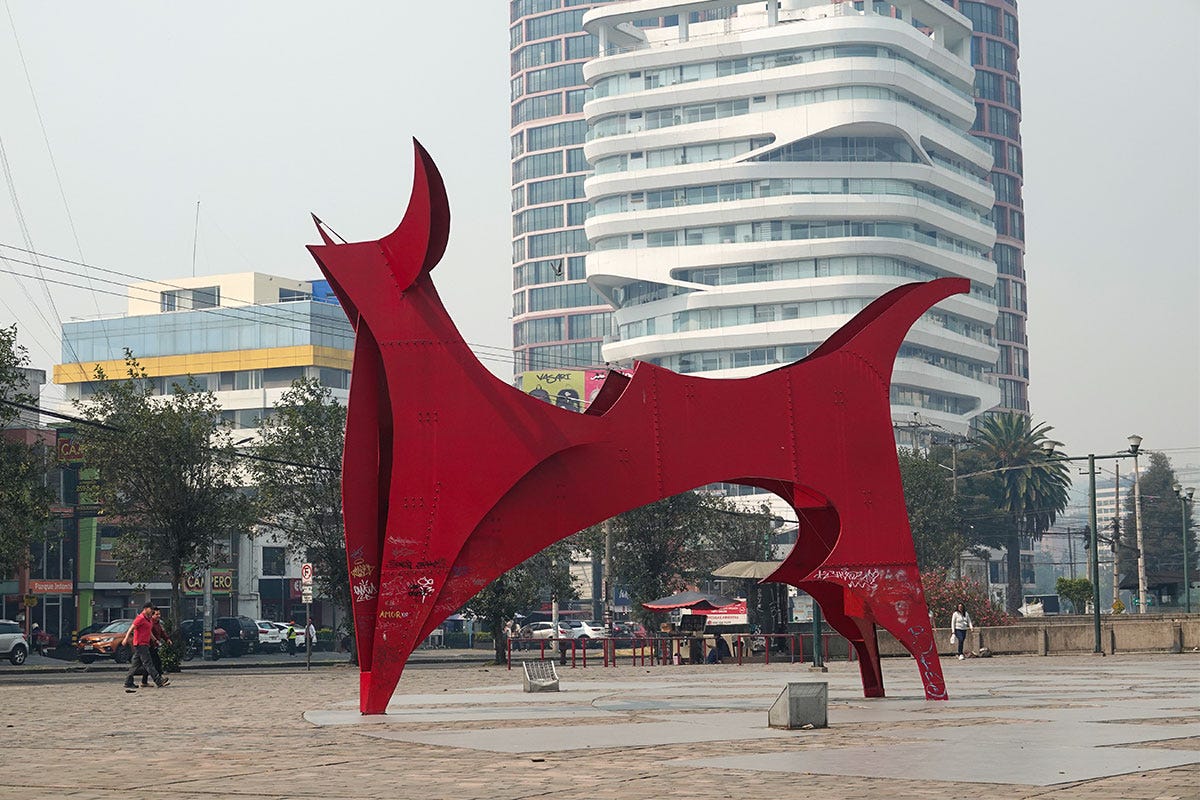
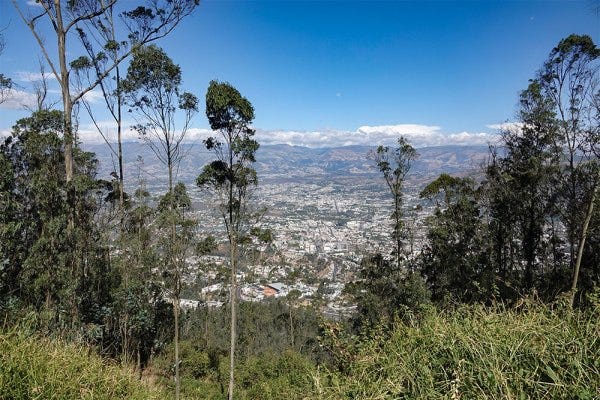
After Otavalo, we arrived in Quito, Ecuador’s capital. It’s the second-largest city in the country, with an estimated population of 2.8 million. Located in the Andes at about 9350 feet, the air is thin, and beer comes out of the taps all foamy. It is thought that the area was first settled sometime between 4400 and 1600 BC, long before the Inca Empire left its mark. The city was in ruins when the Spanish discovered it, so they founded a new one in 1534. Today, much of Quito is modern, with high-rises, distinctive architecture, and a plethora of shopping malls, but its old town remains full of well-preserved colonial buildings. In 1978, Quito became one of the first UNESCO World Heritage sites.
Settling into Quito
But we didn’t come here for all that; we came to learn Spanish
Our original plan was to spend 4 weeks taking Spanish classes. But out of the handful of schools we reached out to, only one replied. And they wanted to sell us private classes instead of group classes. After a disappointing experience with private classes in Medellín, we didn’t want to spend the extra money. And after some thought, we decided that we could save even more money by teaching ourselves.
We settled into the cute, privately owned apartment in the Floresta neighborhood. We subscribed to a handful of websites that focused on different aspects of learning Spanish and started studying 3 hours a day, 5 days a week.
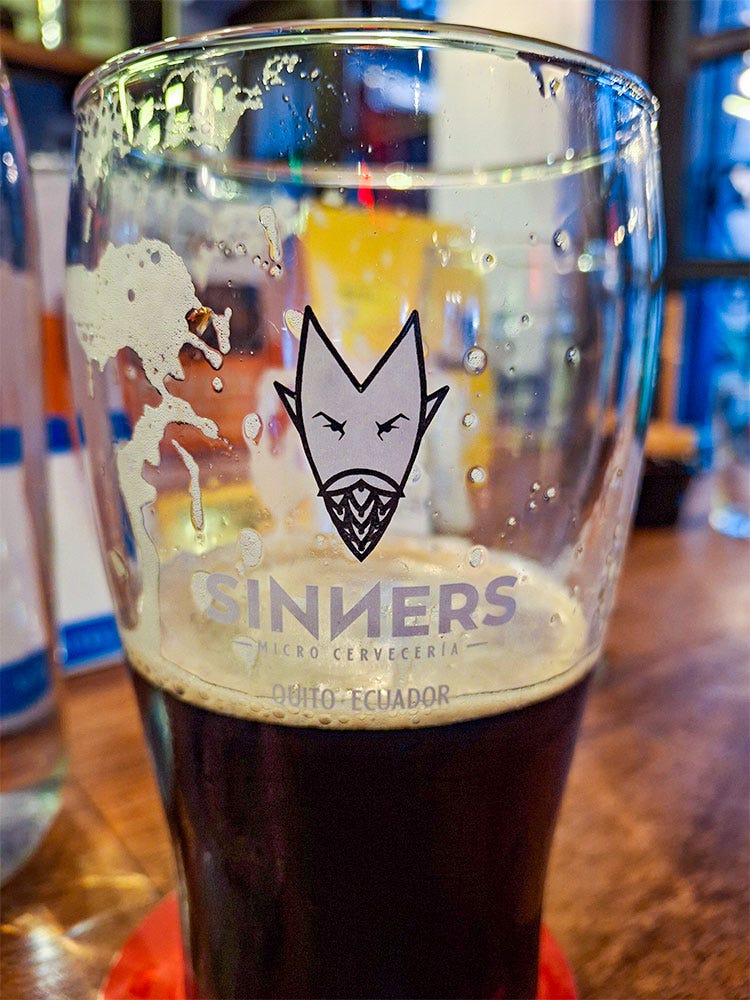
I found a language exchange at a brewpub called VIVA Cerveza! in the La Carolina neighborhood, about 1 3/4 miles north of where we were staying. We could easily walk there in the afternoon when the streets were busy and bright. The meet-up was well organized, the participants, both gringos and Ecuadorians, were all gregarious, and the beer was excellent. Everything was so good that we were always among the last people to leave. Back out on the street, everything was eerily quiet, dark, and eerie. We always took a taxi home.
Being tourists
We were enjoying the rhythm of city life and feeling like a local. But by the end of that first week, we were ready to take a Saturday off, give all the Spanish studying a rest, and be tourists.
The old town, El Centro, was farther than we wanted to walk, so we decided to take the bus.
At the bus platform, we studied the posted system map. We were trying to figure out which stop would let us off closest to the vegan restaurant I found for our lunch. A young woman approached us and asked in English if she could help. I explained where we were planning to get off, and she said the stop was too dangerous. She suggested another route that involved transferring to the metro (subway) and a longer walk to the restaurant. Once she left, Greg and I continued to consider our options. I didn’t want to deal with finding the Metro after we got off the bus or with a longer walk. “How dangerous could it be?” I asked. The direct route just seemed easier. We decided to stay with our original plan.
When we exited the bus platform at our stop, I pulled out my phone to look at Google Maps and see where we needed to go next. We crossed the street to a busy sidewalk crowded with pedestrians walking in either direction. Vendors sat along the sidewalk’s edge, their wares spread out on small blankets. As we made our way down the street, I snapped quick pictures of this somewhat chaotic and fascinating scene. A passerby told me to put my phone away. But I needed it to follow the map to our restaurant. I pulled it close to my chest. We turned a corner, and everything quieted down as we left the busy scene behind.
A fun vegan restaurant
Inside Los Padmito Vegan Restaurant, we felt like we were in some funky eatery in Western North Carolina. Mismatched wooden tables and chairs were surrounded by old cabinets displaying antique crockery, books, and musical instruments. Relics were stacked on shelves, and aging mirrors and paintings were displayed on the walls. The food was great. I took some pictures of it before we dug in.
After our meal, two children (I assume progeny of the proprietors) alternated playing an old piano. They were excellent. Greg took a turn, too. I documented everything with my camera phone.
We left the restaurant and walked a few more blocks towards the plaza. We needed cash, so I looked up an ATM on Google Maps. The line was long. As it moved forward, I noticed a man standing off to the side, maybe 30 feet away. His phone was raised to take a picture of a group of people who were sitting on some steps about 15 feet past the ATM. He stayed that way, with his phone raised the entire time we waited. Was he covertly taking pictures of the ATM? He made me feel uneasy.
I thought about one of the scams I had read about in an Ecuadorian expat group on Facebook. Someone comes up to you and tells you that they saw a bird poop on your back. Under the pretense of being helpful, they help you clean it up while an accomplice robs you.
The crowded Plaza Grande
Once we had our money, we continued to the Plaza Grande. It was super crowded. But all the old architecture was so impressive. There were so many photos to be taken. As we walked around the buildings, I waited patiently for people to move out of my way so I could stretch out my arm with my camera phone to the best angles. I gripped my phone tightly and always pulled it close to my body after I had gotten my shot. I didn’t want to lose my phone again as I did in Medellín. I thought about putting it away and using my “big” camera, which I mainly use for wildlife photography. I carried this camera in a small black camera bag I had bought before we began our South American adventure. I had chosen this bag because it was inconspicuous, had a nice, wide, thick strap, and I thought it could pass as a purse containing less value than a bag with a pricey camera. My “big” camera also has a wide, thick strap, which I always had around my neck when using it, but I worried that more expensive equipment would make me more conspicuous.
Going somewhere that felt safer
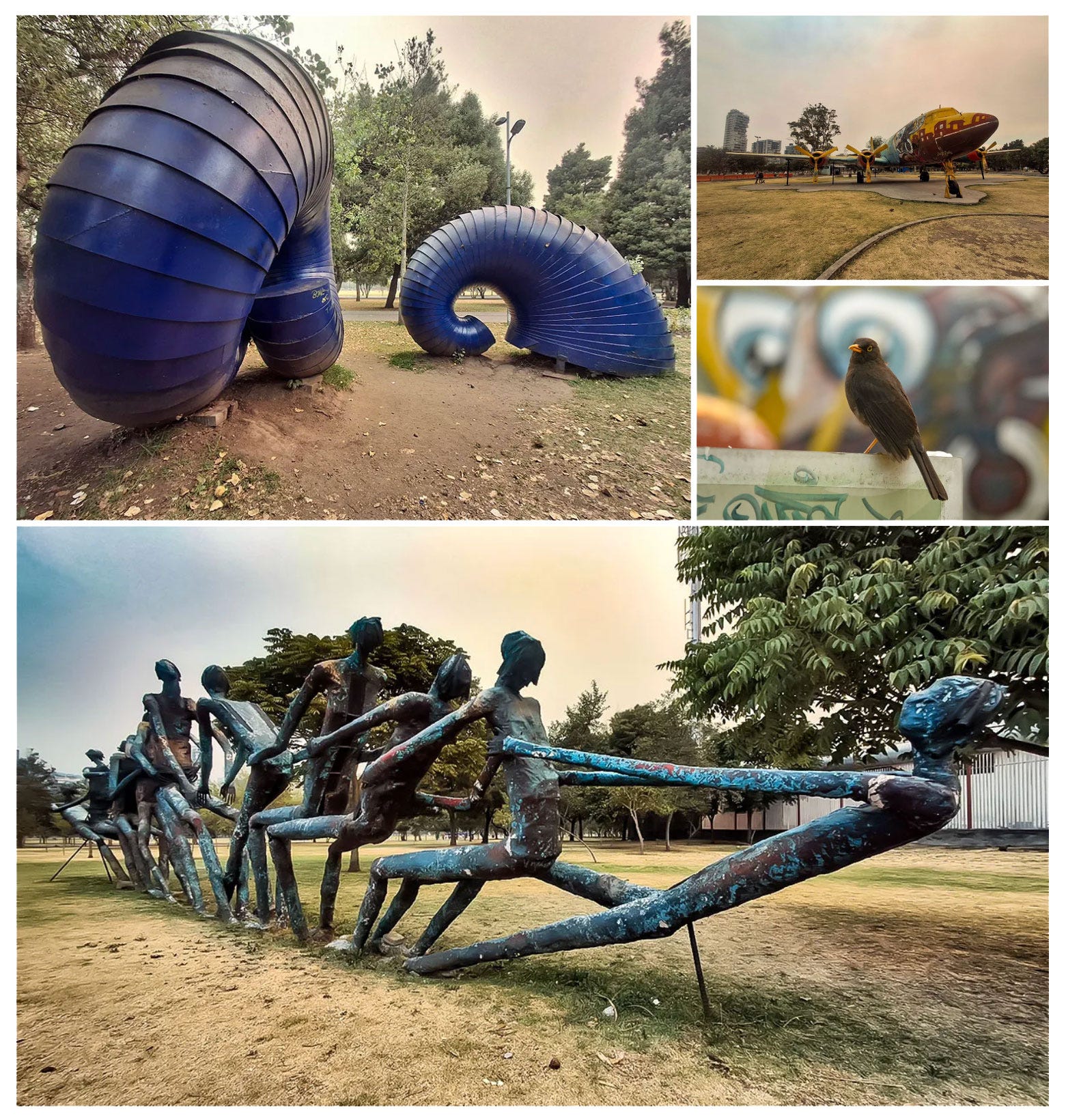
Ultimately, I just wasn’t comfortable, so we decided to move on to a quieter place. We ended up at Parque Bulevar 24 de Mayo, not so much a park as a long, wide pedestrian thoroughfare with some statues, trees in stone planters, and occasional places to sit. Despite a small festival at one end of the park, it was much quieter than the busy area around the plaza. As we walked up the thoroughfare and away from the festival, we didn’t see many people at all. Colonial buildings stood on either side of the park, and I found plenty of interesting views to photograph.
We strolled up to the Monumento al Agulia. We had already decided to leave the area, but I wanted to take just a few last shots looking back on the thoroughfare. Greg was standing behind me. I lifted my phone, and then it was gone. Somebody ran up behind me, grabbed it, and kept going, disappearing between two buildings across the street. I ran after him, knowing I couldn’t catch him, yelling dollar amounts: “cien (100) dolares!” Then upped it: “Doscientos (200) dólares!” I didn’t want to have to go through the trouble of replacing my phone again; I would rather give a thief $200. But he was gone. There were a few people around, but they didn’t even look up at the crazy gringo lady yelling dollar amounts. I asked them if they had seen a man running, but no one had an answer. As I rounded the corner of one of the buildings, heading back towards the park, someone kindly pointed out a cop on a Segway. The Segway cop pointed me to a police substation about 100 yards away.
So many police stations
At the substation, they told us that we needed to see the tourist police. The tourist police were on the other side of the park on a side street. Two cops rode over there on motorcycles, and we followed them on foot. The Tourist Police substation was closed, so we needed to go to yet another police station. This time, we each hopped on the back of one of the motorcycles. We rode down the street, turned back towards the Plaza, and then turned onto a pedestrian walkway, zooming past people, many who had not been robbed, looking at their phones. I so wanted my camera phone to document this little adventure.
At the next station, we were finally able to make our report. Afterward, we flagged down a cab for a quick ride back to the apartment. On the way, I was already trying to solve my new problem.
A failed traveler
I felt like a failure not just as a tourist but as a traveler. I knew better than to do tourist stuff on the weekend when the crowds are bigger. I knew there was a possibility of theft. I let my desire to take copious amounts of photos make us targets. And I wasn’t aware enough of my surroundings or who might be watching us.
My new problem was not only about how to replace the phone but also what to do about taking pictures. We would be in South America for more than another 8 months. I couldn’t NOT take pictures. The first thing I did back at the apartment was to remotely lock my phone and wipe its data. Then I started doing research. I still had my big camera, but I was less comfortable using it in big cities. A small camera was easier, quicker, and less conspicuous for the more casual photos I liked to take. I thought about getting a cheap camera for snapshots and keeping my phone secured in my bag. But I wasn’t finding any suitable options at online camera stores. I thought about ways I could keep my phone safe. Perhaps if I had a glove, some glue, and some tape, I could make a contraption to bind my phone to my hand.
But first I had to replace it. I thought I could hire a mule to bring one from the US. Then, after searching online, I found that Samsung had an Ecuadorian website. But it wouldn’t take my foreign credit card. More web searching yielded a few places in town that sold Samsungs.
We went back and forth numerous times on the bus to La Carolina, where all the big malls were, to cancel my current plan, report the phone stolen with the phone company, Claro, and look for a replacement. Eventually, I found a place that offered a good cash deal on the exact same phone I had. After visiting an ATM, we just needed to visit Claro again to set up service. To secure the phone, I ended up buying a case with a slot for a credit card or ID. I threaded a shoestring through the slot, tightened it, and attached the other end to my camera bag. When I pulled the phone out, I wrapped the shoestring around my wrist. Someone could still steal it, but if they tried, they’d have to bring me with them. I figured that dragging an old gringo lady, kicking and screaming, would at least slow them down.
Back to just studying Spanish
Once the phone problem was settled, we went back to studying Spanish and living like locals. We didn’t go back to El Centro. We didn’t visit any of the historic churches, go to any museums, or ride the teleferiQo. And all the pictures of the street vendors, our lunch, the children and Greg playing the piano, the wonderful architecture of El Centro, the festival, the long visual lines of Parque Bulevar 24 de Mayo were just gone. Never to slowly fade back like my confidence in backpacking through South America.
I’d love to know what you think about this post. Have you been to Quito? Have you ever been robbed while traveling? How did it make you feel? Did you want to quit traveling, or did you just learn and move on? Please let me know in the comments. And please share this post if you found it interesting.
As I follow you two, I find myself drawn into your adventures. However you wrote this one out like it was a crime novel! It was!
Sorry @ the turn of luck, but wishing you continued good fortune on the road to even more travels. 🤓
I've never been to Quito. But I did get robbed in the US, in New Jersey, when I was still just a visitor. Not only my camera (I had no portable phone then), but all my money, documents, and passport were stolen. When we went to the police, they flat-out told me they had no time to try to catch petty thieves. These things happen, no matter where you go. I love your solution with the shoestring, though.